

Price Transparency
Gigasheet Provider Rate Scores: Making Healthcare Prices Easier to Compare

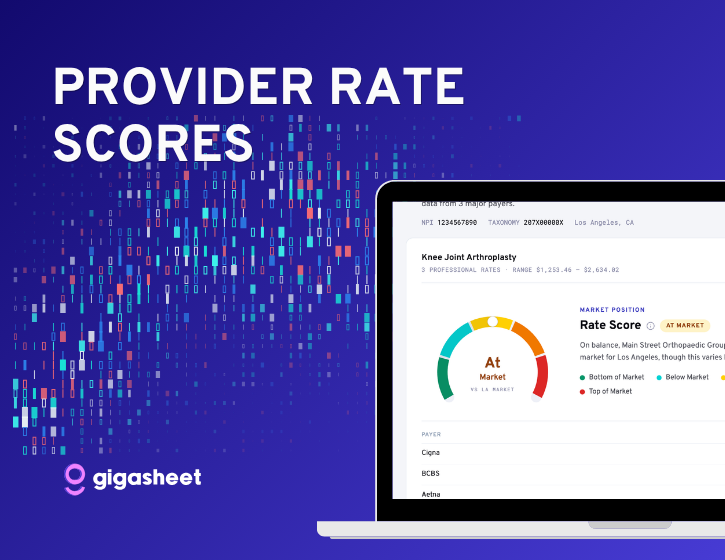
Healthcare price transparency data has been available for some time now, but are buried inside massive, inconsistent, hard-to-use machine-readable files that very few organizations can actually process, normalize, benchmark, and turn into something useful.
That changes with Gigasheet Provider Rate Scores.
Today, we are announcing a new scoring system that benchmarks more than 3 million U.S. healthcare providers using more than 150 billion published negotiated rates. Provider Rate Scores make it easier for care navigation platforms, benefits organizations, healthcare marketplaces, provider directories, self-funded employers, consultants, and health plans to understand whether a provider’s negotiated rates are high or low relative to comparable providers in the same local market.
Think of it like the dollar signs you see on a Yelp review for a restaurant. It does not tell you exactly what dinner will cost, because the final bill depends on what you order. But it gives you a fast, familiar signal for whether that restaurant is generally inexpensive, moderate, or expensive.
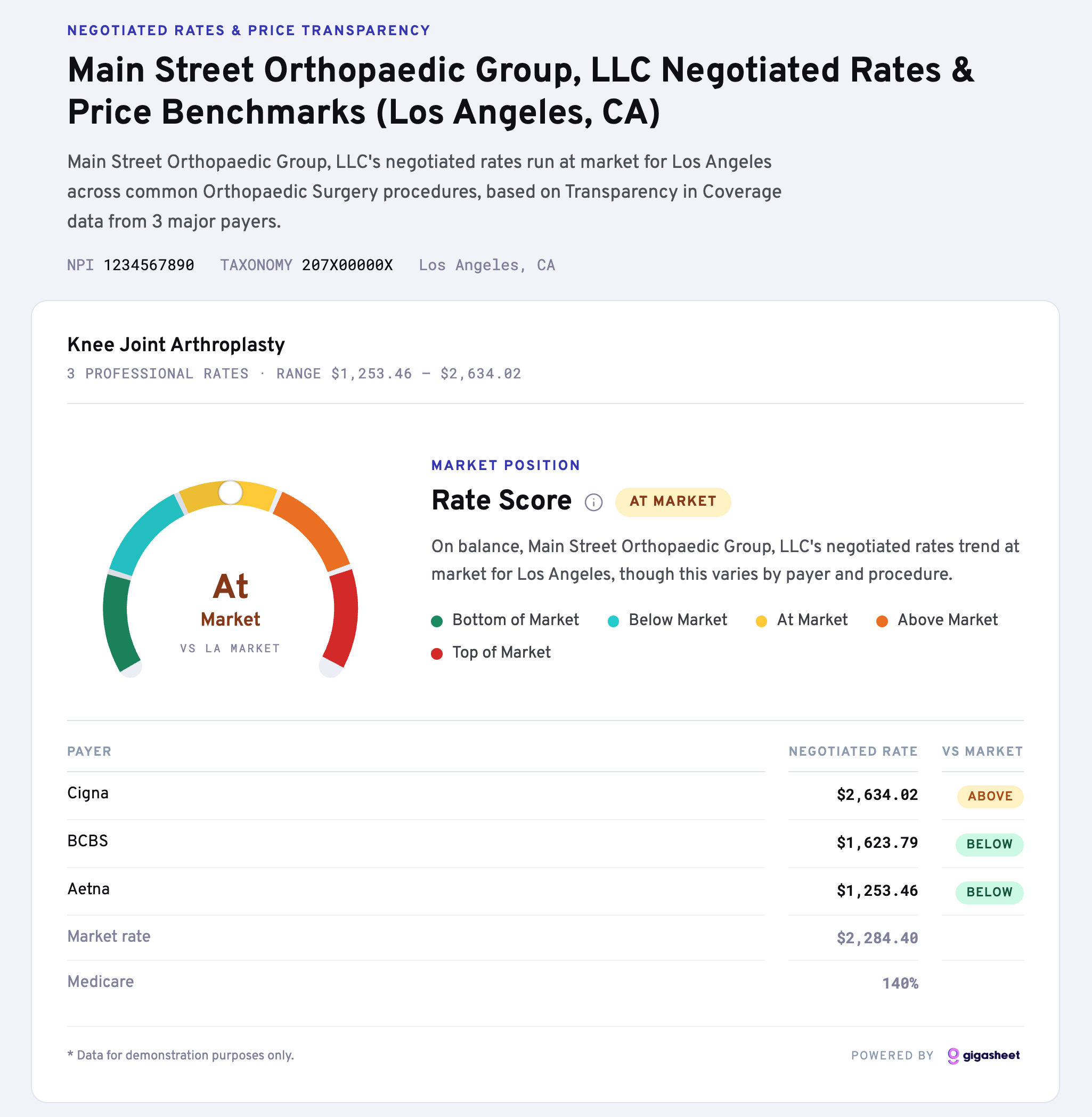
Provider Rate Scores work the same way. They do not predict a patient’s final bill, but they help care navigation, benefits, marketplace, and analytics teams quickly understand whether a provider’s negotiated rates are relatively high or low for a specific service, health plan, specialty, and market.
Price transparency rules created a lot of data. It did not create intelligence.
Federal healthcare price transparency rules have made an enormous amount of negotiated-rate data public. That is real progress. But publishing data and making data usable are two very different things.
A single payer machine-readable file can contain billions of records. Those files often include inconsistent provider names, incomplete identifiers, duplicated rates, outliers, non-comparable billing structures, and formats that change over time.
For a care navigation company, benefits platform, TPA or employer-facing healthcare tool, the question is not, “Can we download a file?” The question is: can we tell whether this provider is relatively expensive or relatively affordable for this procedure, under this health plan, in this market?
That is the problem Gigasheet Provider Rate Scores are designed to solve.
What are Gigasheet Provider Rate Scores?
Gigasheet Provider Rate Scores are directional benchmarks that show how a provider’s negotiated rates compare to relevant peers. Scores are available across multiple levels of detail, including provider, procedure, health plan, specialty, and local market.
- Provider: compare negotiated-rate positioning for individual providers.
- Procedure: understand how rates differ for specific services.
- Payer: see how payer-specific pricing changes the picture.
- Specialty: benchmark providers within clinically relevant groups.
- Local market: compare providers against geographically relevant peers.
This flexibility matters because healthcare price comparison is not one-size-fits-all. A provider directory may need a market-and-specialty signal. A care navigation platform may need procedure-level comparisons. A benefits consultant may want to compare payer positioning across geographies. A self-funded employer may want to understand where members are likely to encounter higher-cost options within a network.
The score preview is just the starting point
One important caveat: the freely availably Provider Rate Scores we publish is just a high-level look. It gives a high-level view of negotiated-rate positioning across select payers, procedures, specialties, and markets.
To put Provider Rate Scores to work in a real decision workflow, organizations need more specific scoring: the provider, the procedure, the member’s insurance, and the local market. Rates can vary widely from payer to payer, even for the same provider and procedure. In addition to the score, we provide clear evidence - the actual rates published by payers. That specificity is where the score becomes operationally useful.
The Smart Rate work behind the score
The hard part is not displaying a score. The hard part is the data preparation and data science: creating a score that is based on clean, comparable, continuously updated data.
Gigasheet ingests, cleans, normalizes, enriches, and benchmarks healthcare price transparency data at national scale. Our Smart Rate methodology identifies anomalous and non-comparable rates, aligns providers and procedures across inconsistent source files, and produces benchmarks that support provider-to-provider and payer-to-payer comparisons.
This is where a lot of healthcare price transparency efforts break down. Raw rates are not intelligence. A spreadsheet full of prices is not a benchmark. A machine-readable file is not a product experience.
The value comes from turning fragmented public data into something that can be queried, compared, explained, and embedded into real workflows. That is what we built.
Why Provider Rate Scores matter for healthcare decision-making
For years, healthcare consumers, employers, and benefits teams have been told that transparency will make the market work better. I believe that is true. But transparency only works when people can understand and act on the information.
Most patients are not going to parse payer files. Most HR teams are not going to normalize billions of negotiated rates. Most product teams building provider search, care guidance, or healthcare marketplace experiences do not want to spend years building data infrastructure before they can show users a simple pricing signal.
They need usable intelligence.
- Which providers appear relatively high-cost or low-cost for a given procedure in this market?
- How does pricing vary by payer for the same provider or service?
- Which providers should be surfaced with additional price context in a navigation workflow?
- Where are there meaningful pricing differences between comparable providers?
- How can healthcare products give users a clearer signal without overwhelming them with raw data?
This is not about replacing clinical judgment. It is not about reducing healthcare decisions to price alone. And it is not a prediction of a patient’s final out-of-pocket cost. It is about adding a missing layer of pricing intelligence to healthcare decision-making.
Who Provider Rate Scores are built for
Provider Rate Scores are designed for organizations that help people make healthcare decisions or analyze healthcare markets.
- Care navigation platforms
- Member benefits partners
- Provider directories
- Healthcare marketplaces
- Review and search platforms
- Self-funded employers
- Benefits consultants
- Health plans
- Provider organizations
- Healthcare data and analytics teams
For example, a care navigation platform could use Provider Rate Scores to compare surgeons for a particular procedure under a member’s health plan. A provider directory could add a simple pricing signal by specialty and geography. A benefits consultant could evaluate how different health plans perform across markets. A healthcare marketplace could help users understand relative pricing without exposing them to the complexity of machine-readable files.
That is the point: make the intelligence easy to use, even when the underlying data is massive and messy.
From price transparency to Healthcare Price Intelligence
The healthcare industry does not need more raw data dumps. It needs Healthcare Price Intelligence.
That means clean data, normalized entities, market benchmarks, proprietary scoring, high-performance analytics, APIs, bulk data delivery, and product-ready signals that can be built into real workflows.
Provider Rate Scores are part of that larger vision. At Gigasheet, we believe healthcare price transparency data is becoming critical infrastructure for the next generation of healthcare products. But infrastructure only matters when people can build on it.
Our job is to make that possible.
Put Provider Rate Scores to work
Compare provider pricing by payer, procedure, specialty, and market without managing raw transparency files or building your own healthcare data warehouse.
Explore the APIView Price Transparency ExplorerFrequently Asked Questions
What is a Provider Rate Score?
A Provider Rate Score is a directional benchmark that shows whether a provider’s negotiated rates are high or low relative to comparable providers in the same market.
Does a Provider Rate Score predict a patient’s final bill?
No. Provider Rate Scores are not patient bill estimates. Actual patient costs can vary based on plan design, benefits, site of service, additional services, and other factors.
Is the score a measure of clinical quality?
No. Provider Rate Scores measure negotiated-rate positioning. They are not clinical quality scores and should not be interpreted as recommendations of a specific provider.
What data powers Provider Rate Scores?
Provider Rate Scores are powered by Gigasheet’s analysis of more than 150 billion published negotiated rates from healthcare price transparency files, combined with proprietary normalization, enrichment, benchmarking, and scoring methods.
Who can use Provider Rate Scores?
Provider Rate Scores are built for care navigation platforms, benefits organizations, provider directories, healthcare marketplaces, self-funded employers, consultants, health plans, and other organizations that need healthcare pricing intelligence.
How can organizations access Provider Rate Scores?
Gigasheet customers can access Provider Rate Scores through the API, or bulk data delivery, depending on their use case.
Healthcare price intelligence

Similar posts
.png)
.png)
.png)


