

Price Transparency
How Healthcare Network Teams Use Price Transparency Data to Find Provider Prospects

Can price transparency data actually improve provider network development? For teams that can get it into a usable format, yes, and significantly.
Healthcare organizations have more market data available than ever. The problem is that much of it is too large, fragmented, or difficult to use in day-to-day provider recruitment workflows.
That matters because provider network gaps are operationally expensive. If a plan, managed care organization, or network intermediary cannot find the right providers in the right markets, members may face delays, out-of-network referrals, or limited access. For network teams, the work often turns into a manual search process: find providers, confirm location and specialty, assess fit, compare options, and decide who to contact first.
Price transparency data can change that workflow. But only if teams can turn it into usable market intelligence.
What is price transparency data in provider network development?
Price transparency data includes publicly available negotiated rates and related healthcare pricing information. For network development teams, this data can support market intelligence by showing which providers are active in a market, what services they appear to offer, and how their rates compare.
In provider network development, price transparency data can help teams answer practical questions:
- Which providers are active in a target geography?
- Which specialties or service lines appear in a given market?
- Which billing codes are associated with relevant providers?
- How do provider rates compare across the market?
- Where should outreach begin based on network expansion priorities and rate signals?
The challenge is that price transparency data was not designed for easy operational use. Raw machine-readable files can be massive. They often include duplicated rows, nested structures, inconsistent naming, and more detail than a business user can realistically review in a spreadsheet.
That is where healthcare teams need a different approach: not just access to data, but a way to filter, compare, and act on it.
Why does manual provider prospecting fail to scale?
For many network development teams, provider recruiting still starts with basic web searches.
That approach can work for a small market or a narrow specialty. It breaks down when teams need to evaluate multiple geographies, service categories, billing codes, and competitive rate signals at once.
Manual search creates three common problems:
- It is slow. Building a qualified target list can take hours per market.
- It is incomplete. Search results may miss relevant providers, especially smaller or less digitally visible organizations.
- It lacks pricing context. Teams may find a provider, but still lack insight into how that provider compares in the market.
For healthcare organizations managing large provider networks, these are not minor workflow issues. They directly affect how quickly teams can strengthen network coverage and prioritize outreach.
How can price transparency data improve provider recruitment?
Price transparency data improves provider recruitment by giving network teams a structured way to identify potential providers, compare market options, and prioritize outreach based on geography, specialty, billing codes, and rate competitiveness.
With the right workflow, teams can use price transparency data to:
- Find providers in target markets
- Identify specialties tied to relevant billing codes
- Compare provider rate tiers
- Cross-reference provider options against network expansion priorities
- Build more complete outreach lists
- Prioritize outreach based on market coverage and competitive signals
This shifts provider prospecting from broad search to targeted market analysis.
Instead of asking, "Who can we find online?" network teams can ask, "Which providers appear in the data, where are they located, what services are associated with them, and how should we prioritize outreach?"
Example: HOMELINK's network development workflow
HOMELINK®, a division of VGM Group, Inc., uses Gigasheet's Price Transparency Explorer to support provider network development.
Their network development team recruits and credentials providers across categories including physical therapy, chiropractic care, acupuncture, DME, home health, and other ancillary services. The goal is straightforward: identify the right providers in the right markets and expand network coverage efficiently.
Before using Gigasheet, Network Development Executive Ben Yurk built provider prospecting lists through manual Google searches. A single market could take about three hours to research. Producing 150-200 qualified weekly targets could take around six hours. Even then, conventional search could miss providers that were relevant to HOMELINK's needs.
With Gigasheet, the workflow changed.
Instead of starting with broad web searches, Yurk can filter price transparency data by geography, specialty, and billing code. He can then compare those results against HOMELINK's internal network heat map to identify where the network has room to grow and which providers may be strong prospects.
"When you're able to look at a map and cross-compare with our heat map," Yurk says, "you can immediately find the best options for growth."
The result is a more structured view of the market. Provider locations, specialties, and rate tiers become easier to evaluate. Outreach becomes more targeted. The team can spend less time searching and more time recruiting.
What results did HOMELINK see with Gigasheet?
HOMELINK's network development team reported measurable improvements after using Gigasheet's Price Transparency Explorer:
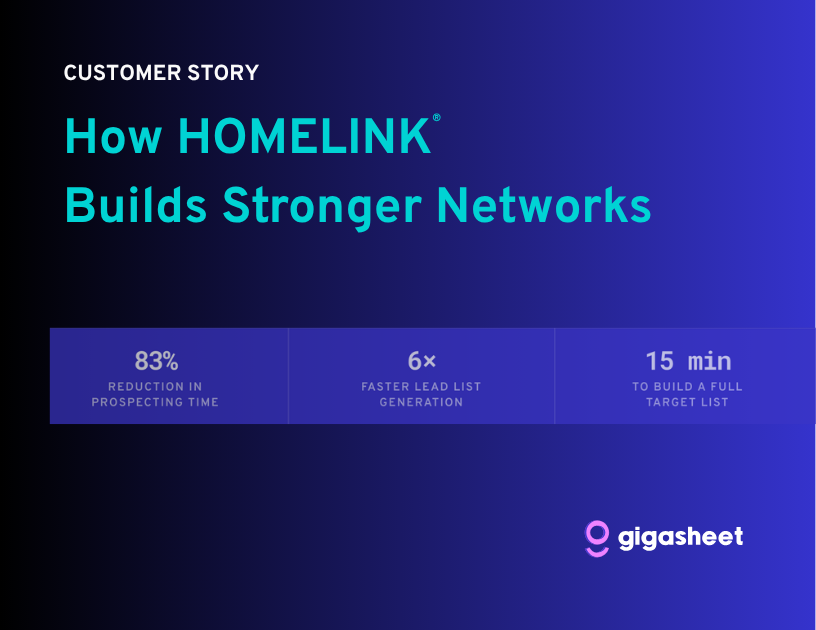
- Target list creation reduced from about 3 hours to 15 minutes
- Weekly lead generation for 150-200 qualified targets reduced from about 6 hours to 1 hour
- Individual provider lookups reduced from 5-10 minutes to about 15 seconds
- About 50% conversion rate on Gigasheet-sourced leads
- 25-40 providers contracted that were previously difficult to find through conventional search
One quote captures the operational value clearly:
"I would have never found this provider if it weren't for Gigasheet. That was the first one where I was like, this is actually going to make an impact in my day-to-day." — Ben Yurk, Network Development Executive, HOMELINK
For network development teams, that is the point. Better data workflows do not just save time. They can change which providers make it into the pipeline.
How does Gigasheet support healthcare market intelligence?
Gigasheet's Price Transparency Explorer helps healthcare teams search, filter, group, and analyze large price transparency datasets in a spreadsheet-like interface built for operational workflows.
Teams can use Gigasheet to evaluate providers by geography, specialty, billing code, and rate information, then connect those insights to network development, payer contracting, market coverage, and provider recruitment workflows.
For HOMELINK, this means faster prospecting, stronger market visibility, and provider opportunities that were previously easy to miss.
FAQ: Price transparency data for provider network development
How can price transparency data help provider network development?
Price transparency data can help network development teams identify providers in target markets, compare rate signals, and prioritize outreach based on expansion priorities. It gives teams a more structured way to evaluate provider opportunities than manual web search alone.
What makes price transparency data difficult to use?
Price transparency data is often large, duplicated, fragmented, and difficult to analyze with traditional spreadsheets. Raw files can include inconsistent naming, nested structures, and more rows than standard desktop tools can handle.
What provider types can be analyzed with price transparency data?
Depending on the available data, teams may evaluate providers across categories such as physical therapy, chiropractic care, DME, home health, diagnostic services, and other specialties.
How did HOMELINK use Gigasheet?
HOMELINK used Gigasheet's Price Transparency Explorer to filter providers by geography, specialty, and billing code, then compare those results against internal network priorities. This helped the team identify provider prospects faster and find providers that conventional search had missed.
What results did HOMELINK achieve?
HOMELINK reduced target list creation from about three hours to 15 minutes, cut weekly lead generation time from about six hours to one hour, and contracted 25-40 providers that were previously difficult to find through conventional search.
Read the full HOMELINK customer story
HOMELINK's story shows how healthcare organizations can turn price transparency data into practical provider recruitment intelligence.
Read the full customer story to see exactly how HOMELINK's team filters by geography, specialty, and billing code, then cross-references results against internal network heat maps to find providers no other method could surface — including the workflow, the numbers, and what it means for healthcare network teams working at scale.
Healthcare price intelligence

.png)
%252520(3).png)
.png)


