



Gigasheet vs. Turquoise Health at a Glance
Turquoise Health is built as a broad enterprise platform spanning pricing, contracts, claims validation, patient estimates, compliance, and transaction workflows. That breadth can be valuable, but it typically requires a larger implementation, ongoing services, and greater commitment to the Turquoise operating model. It is not a lightweight solution.
Gigasheet is more focused and adaptable. It gives analysts, applications, and AI agents direct access to a healthcare market-intelligence engine for benchmarking, custom analysis, on-demand MRF processing, proprietary data integration, and embedded intelligence.
The choice is not whether either platform can find a rate. It is whether you want a comprehensive, services-intensive operating environment or a faster, more flexible platform that adapts to your questions and workflows.
Where Gigasheet is different
Let the question define the workflow
Turquoise Analyze provides useful templates, filters, charts, utilization profiles, report creation, and searches across original MRF data already in its environment. Gigasheet's distinction is that the analytical model itself is open to the user. Filter complete datasets, group and aggregate, build and change pivots, create formulas and calculated fields, apply conditional logic, join additional datasets, transform text, codes, and dates, build custom cohorts and scores, and inspect individual source records. When the benchmark reveals the next question, reshape the analysis instead of changing products. Turquoise organizes the work around healthcare workflows. Gigasheet lets the question define the workflow.
Assign the market study, not just the question
Both platforms have credible AI. Turquoise's AskTQ searches and analyzes rates, contracts, and payer policies, supports conversational follow-up, and generates structured summaries and decision support. Gigasheet's native in-app Agent is built for a different standard of work: sustained multi-step analysis. Give it a market objective and it resolves the relevant providers, selects procedures, payers, and markets, builds comparison cohorts, applies Smart Rate methodology, calculates Medicare and local benchmarks, tests alternative approaches, investigates anomalies, and produces a complete, full-form report with every conclusion linked to the underlying records. Gigasheet also offers MCP so compatible external AI tools can use the same data and analytical capabilities. Ask a question in Turquoise. Assign the market study in Gigasheet.
Bring the file your decision depends on
Turquoise's Analyze experience centers on Clear Rates and original MRFs already ingested into its managed environment. Gigasheet additionally makes customer-selected MRF processing a core product capability. Upload hospital machine-readable files directly, request on-demand processing of payer and self-funded plan files, analyze newly published files immediately, and compare a selected file with national market data. Supported inputs include JSON, CSV, and compressed files up to 250GB. Use the national dataset, or bring the exact file your decision depends on.
Score the provider, not just the rate
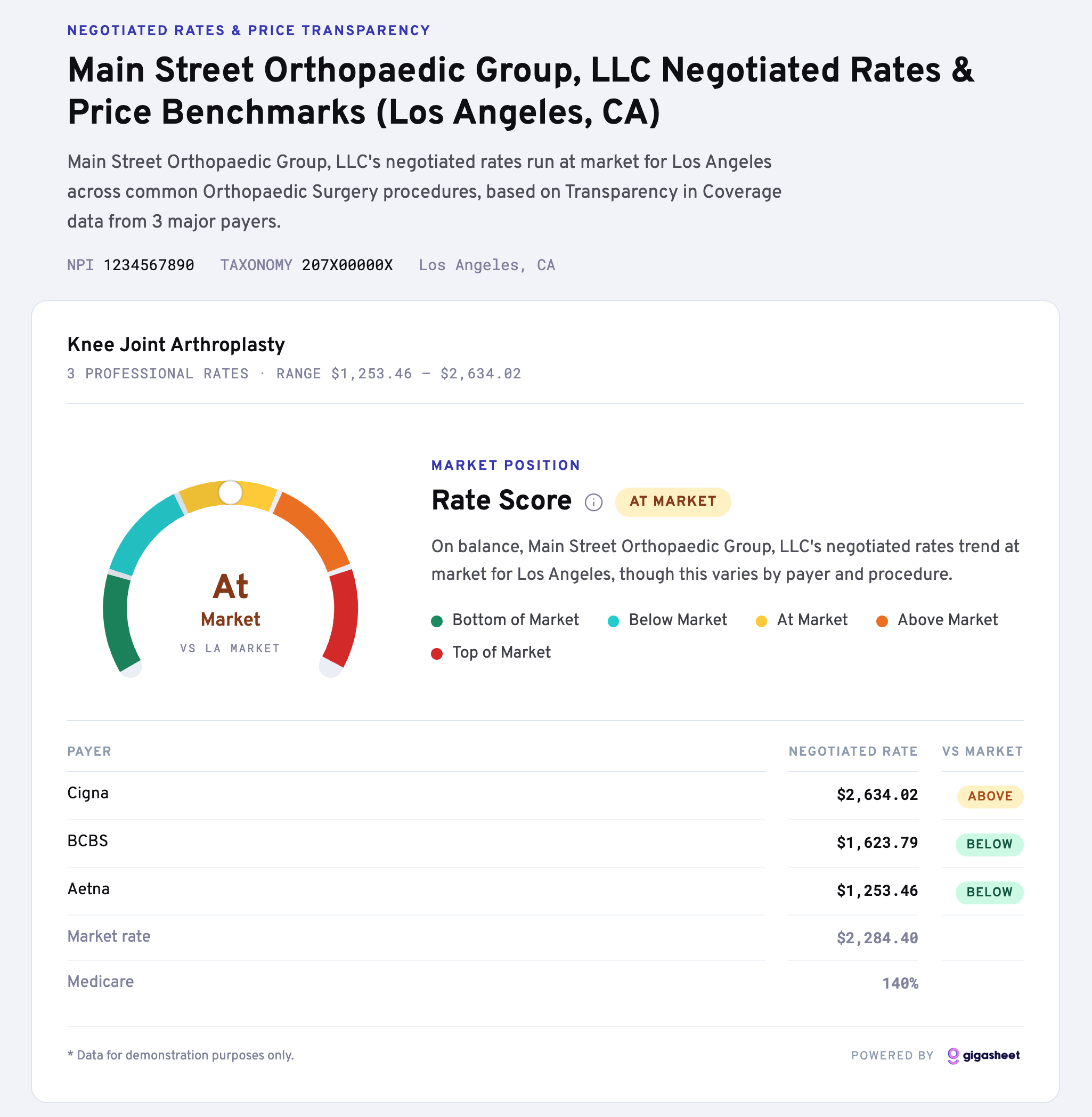
Both companies use the phrase Rate Score, and the two metrics answer different questions. Turquoise Rate Scores measure confidence in the validity and selection of an underlying rate, which supports data trust. Gigasheet Provider Rate Scores measure a provider's relative negotiated-rate market position by payer, procedure, specialty, and local market, which supports decisions about providers: care navigation, directories, marketplaces, network development, benefits analysis, recruitment, and contract strategy. Gigasheet's AI provider search, built on vector search and fuzzy matching, resolves incomplete, misspelled, or ambiguous provider queries first, so you are scoring the entity you meant, and every score opens to the underlying negotiated rates. Provider Rate Scores measure negotiated-rate market position. They do not measure clinical quality, predict patient responsibility, or represent what a provider charges a patient.
What you get with Gigasheet
- More than 150 billion negotiated rates from payer Transparency in Coverage files and hospital price transparency files, normalized and enriched
- Nationwide Provider Rate Scores across more than 3 million providers, analyzable by provider, payer, procedure, specialty, and local market
- Smart Rate filtering, Medicare and local market benchmarks, and access to the supporting source rows behind every result
- Direct hospital MRF upload and on-demand processing of selected payer and self-funded plan files, up to 250GB per file
- AI provider search using vector search and fuzzy matching to resolve incomplete or ambiguous provider queries
- A native in-app AI Agent that conducts sustained multi-step investigations and produces full-form reports with supporting evidence
- Your claims, contracts, rosters, utilization, and proprietary datasets joined against market rates in the same workspace
- An API that retrieves records or executes formulas, grouped calculations, statistics, Smart Rate logic, and custom benchmarks
- MCP access so external AI tools can use the same healthcare data and analytical engine
- Row-level traceability from any insight back to the source machine-readable file
When Turquoise Health may be the better choice
Turquoise Health may be a strong fit for organizations that want a broad, highly managed suite spanning pricing, contracts, claims validation, patient estimates, compliance, and transaction workflows, and are prepared for the cost, implementation, and services that come with it.
Turquoise helped define the category, but buyers now have credible alternatives.
Choose Gigasheet when you want reimbursement intelligence with greater analytical freedom, on-demand MRF processing, autonomous research, and intelligence you can customize, automate, and embed.
Frequently asked questions
Is Gigasheet an alternative to Turquoise Health?
Yes. Both platforms provide healthcare price transparency data, market benchmarks, AI capabilities, APIs, MCP access, and analytical tools. Gigasheet is particularly well suited to organizations that need open-ended analysis, autonomous full-report research, customer-selected MRF processing, Provider Rate Scores, direct data manipulation, or embedded analytical calculations.
What is the main difference between Gigasheet and Turquoise Health?
Turquoise Health provides a broad platform spanning pricing, contracts, payer policies, reimbursement modeling, estimates, compliance, and healthcare transactions. Gigasheet is focused on healthcare market intelligence: users and AI agents can filter, group, pivot, join, calculate, transform, and report on national price transparency data and customer-supplied files through one analytical engine.
Does Turquoise Health support flexible analytics?
Yes. Turquoise Analyze supports real-time filters, custom charts, utilization profiles, report templates, original-MRF searches, exports, and custom reporting. Gigasheet's distinction is a more general analytical model with direct formulas, joins, pivots, transformations, customer-selected file processing, and continued analysis outside a defined workflow.
Do both platforms have AI and MCP?
Yes. Turquoise AskTQ searches and analyzes rates, contracts, and payer policies, with conversational questions, summaries, comparisons, and decision support, and the Turquoise Connector provides MCP access to Clear Rates and its healthcare knowledge graph. Gigasheet provides MCP access as well, and its native in-app AI Agent is designed to independently execute multi-step market investigations and produce complete reports grounded in the analytical engine and supporting data.
Can Gigasheet analyze an MRF that is not already in its national database?
Yes. Upload hospital machine-readable files directly or request processing of payer files, including self-funded plan MRFs. Gigasheet supports JSON, CSV, and compressed files up to 250GB.
Can Turquoise Health search original MRF data?
Yes. Turquoise Analyze lets users search hospital and payer MRF data already available within the Turquoise environment. Gigasheet additionally markets direct and on-demand processing of customer-selected MRF files as a core product capability.
How are Gigasheet Provider Rate Scores different from Turquoise Rate Scores?
They answer different questions. Gigasheet Provider Rate Scores measure relative market position: whether a provider's negotiated rates are relatively high or low compared with relevant peers in the same payer, procedure, specialty, and market. Turquoise Rate Scores measure confidence in the validity and selection of an underlying rate.
Does Gigasheet include claims data?
Gigasheet does not position a proprietary national commercial claims corpus as a standard component of its price transparency dataset. Customers can combine their own claims and utilization data with Gigasheet's rates, Provider Rate Scores, benchmarks, and analytical engine. Turquoise uses claims benchmarks and historical claims data in Clear Rates and its consumer-pricing methodologies.
Can Gigasheet estimate a patient's out-of-pocket cost?
No. Provider Rate Scores measure relative negotiated-rate position, not patient responsibility. Turquoise offers dedicated Consumer Pricing API and estimate capabilities for supported patient-pricing workflows.
Can Gigasheet combine our data with market data?
Yes. Upload or connect claims, contracts, provider rosters, network information, utilization, geographic data, and other proprietary datasets, then join and analyze them alongside national price transparency data.
Does Gigasheet replace Turquoise contract management?
No. Gigasheet provides market intelligence that supports contract negotiations and reimbursement strategy, but it is not positioned as a contract lifecycle-management system. Turquoise may be the stronger fit when the buyer needs a contract repository, AI term extraction, policy monitoring, contract comparison, and scenario modeling in one platform.
Which platform is simpler to adopt?
That depends on scope. Gigasheet is focused on price intelligence, analysis, AI reporting, MRF processing, APIs, and data delivery. Turquoise can cover a much broader set of pricing, contract, policy, estimate, and transaction workflows. Compare implementation scope, required modules, total cost, and time to value for the specific job you need to complete.
How does Gigasheet pricing work?
Gigasheet offers a free tier to get started and flexible pricing that scales with the size of your analysis. Turquoise uses custom, scoped enterprise pricing, so we do not make a direct cost comparison.
Comparison based on publicly available product information reviewed August 21, 2026. Features, product availability, data coverage, and positioning may change. Turquoise Health is a trademark of its respective owner and is not affiliated with or endorsed by Gigasheet.
Drive Growth with Market Intelligence

Let the Question Define the Workflow
Open-ended filters, groups, pivots, formulas, joins, and transformations on the full dataset, with row-level inspection of every result. When the benchmark reveals the next question, reshape the analysis instead of changing products.

Assign the Market Study
Gigasheet's native in-app AI Agent independently resolves providers, builds peer groups, applies benchmarks, investigates anomalies, and produces a complete report. MCP connects external AI tools to the same engine.

Bring the File That Matters
Upload hospital MRFs directly or request on-demand processing of payer and self-funded plan files, up to 250GB. Analyze newly published or customer-specific data without waiting for a standard national refresh.


