

Serif Health Alternative
Gigasheet is the price intelligence alternative for teams that need more than answers from a managed pricing dataset. Benchmark reimbursement with nationwide negotiated rates, then investigate the drivers, process the machine-readable files your question requires, join your own claims and contracts, automate the analysis, and build intelligence products in one platform.
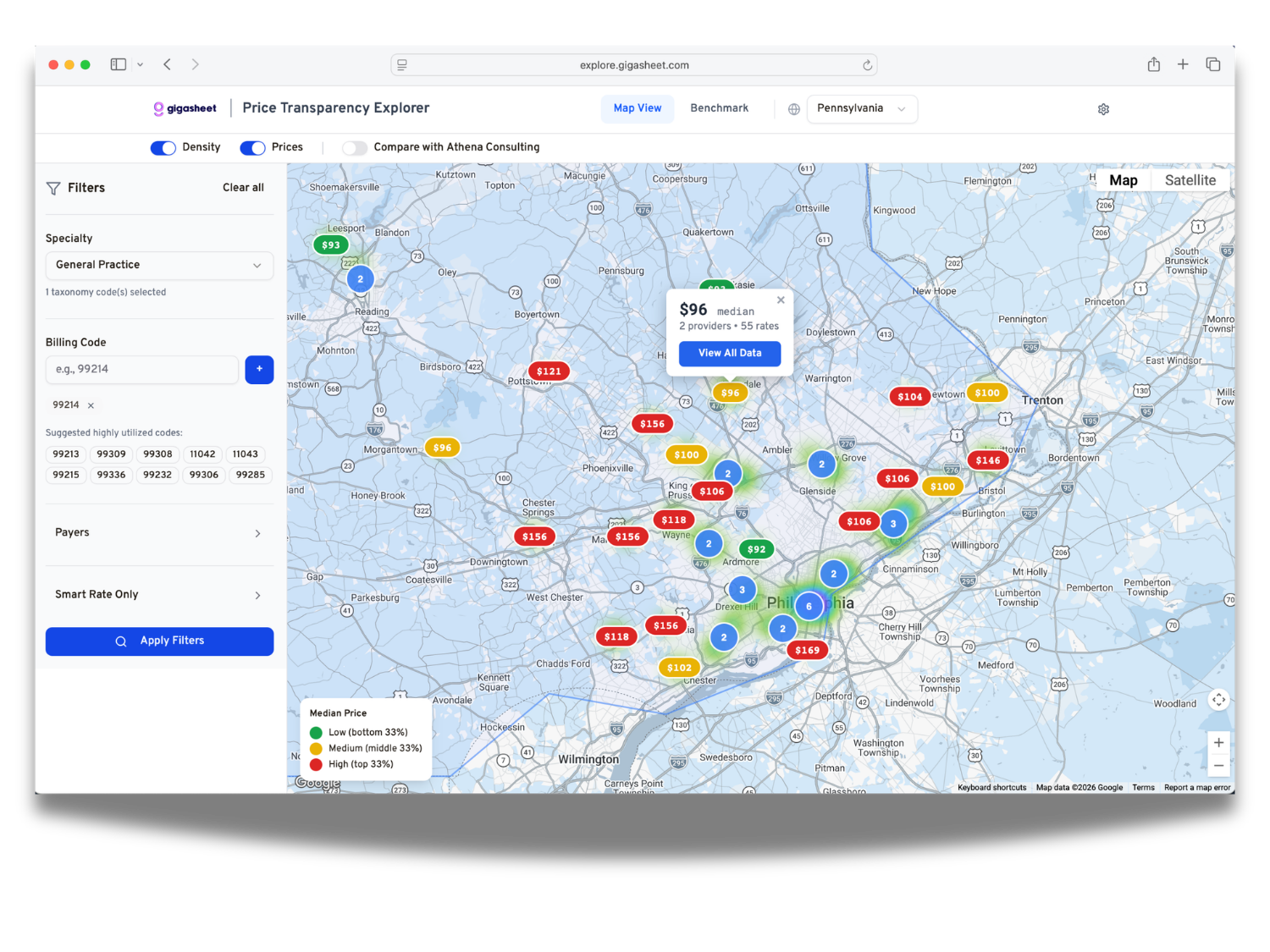


Gigasheet vs. Serif Health at a glance
Serif Health is a credible competitor and a genuinely broad one. Signal searches negotiated rates, fee schedules, and market distributions. The Neuron, Find Care, and Provider Directory APIs cover rate lookup, cost-aware care navigation, and provider-practice-payer relationships. Bulk delivery ships CSV, Parquet, Snowflake, and Databricks. Signal Ask answers pricing questions in natural language and is promoted as a limited beta, and production MCP servers connect those APIs to ChatGPT, Claude, and other compatible agents. Serif states coverage of more than 200 commercial payers, 4,700 hospitals, 9 billion claims, and 250 million lives, and uses claims to remove clinically irrelevant zombie rates, compare published rates with paid amounts, and add utilization context.
Both platforms benchmark reimbursement. The difference is the analytical ceiling. Gigasheet pairs nationwide price transparency data with an engine you can point at any question: inspect the records behind a benchmark, change the methodology, process a file that is not in a managed inventory yet, join your own data, automate the recurring work, and deliver the result through the application, an API, a native AI Agent, or your own product.
Where Gigasheet is different
The benchmark is the starting point, not the output
Both platforms answer the common reimbursement questions. Gigasheet lets you keep going from the answer. Drill from a Provider Rate Score to the market percentile, break it out by payer and procedure, open the underlying negotiated rates, then change the methodology instead of changing products. Build filters, pivots, calculated columns, conditional logic, joins, regular expressions, statistics, and grouped aggregations against the full dataset, and save the whole thing as a repeatable workflow. Serif's Signal is built to return supported pricing workflows and market distributions well. Gigasheet is built so the next question does not require a different tool or a support ticket.
Analyze the files your question requires, including your own data
Serif's public products center on its managed payer, hospital, provider-affiliation, and licensed claims inventory, accessed through Signal, purpose-built APIs, and delivered datasets. Gigasheet works from nationwide data as well, and adds two things. You can upload hospital machine-readable files directly or request on-demand processing of selected payer and self-funded plan files, which matters when the source is newly posted, a specific employer plan, a regional payer, or a file a customer handed you. You can also bring claims, contracts, remittance, provider rosters, utilization, referral patterns, and internal benchmarks into the same environment and join them against market rates. That is not a file upload feature. It is what makes the price intelligence specific to your organization.
Provider Rate Scores, then every rate behind them
Serif offers provider search through Find Care and the Provider Directory API, network status, provider-practice-payer relationships, market distributions, and percent-of-Medicare benchmarks. Gigasheet leads with provider-level intelligence: nationwide Provider Rate Scores by provider, payer, procedure, specialty, and local market, alongside market percentiles, Medicare comparisons, and Smart Rate logic that excludes outliers and non-comparable records so the comparison is closer to apples to apples. Intelligent provider matching using vector search and fuzzy matching resolves incomplete, misspelled, or ambiguous provider queries first, so you are scoring the entity you meant. Move from millions of published rates to an immediate signal of where a provider stands, then inspect every rate behind the result. Provider Rate Scores measure relative negotiated-rate position. They are not a clinical quality measure and they do not predict what a patient will owe.
An AI Agent that conducts the analysis
Both platforms support AI. Serif promotes Signal Ask for natural-language pricing, network, rate, and benchmark questions, currently as a limited beta, plus production MCP servers that connect its APIs to compatible AI applications. Gigasheet provides MCP access as well, and adds a native AI Agent that runs on the analytical engine underneath it. Give the Agent a market objective and it finds the relevant providers, selects the data, filters, joins, and aggregates, applies benchmarks, investigates anomalies, compares alternative markets, builds charts and tables, and returns a complete report with the supporting records attached. The distinction is the depth and duration of the work the AI performs, not whether AI exists on both sides.
What you get with Gigasheet
- More than 150 billion negotiated rates from payer Transparency in Coverage files and hospital price transparency files, normalized and enriched
- Nationwide Provider Rate Scores across more than 3 million providers, analyzable by provider, payer, procedure, specialty, and local market
- Smart Rate logic and Medicare benchmarks, with the excluded and supporting records still available for inspection
- Direct hospital MRF upload and on-demand processing of selected payer and self-funded plan files
- Your claims, contracts, rosters, utilization, and proprietary datasets joined against market rates in the same workspace
- Intelligent provider matching using vector search, fuzzy matching, and natural-language search
- A native in-app AI Agent that conducts multi-step investigations and produces full-form reports with supporting evidence
- An analytics API that goes past retrieval: formulas, grouped aggregations, statistics, Smart Rate logic, Medicare comparisons, and custom benchmarks
- MCP access so external AI tools can use the same healthcare data and analytical engine
- Custom datasets, bulk data products, and row-level traceability from any insight back to the source machine-readable file
When Serif Health is the better choice
Serif is a strong fit for a clear set of requirements. Choose it if the priority is a managed pricing dataset you do not want to operate yourself, a large licensed claims asset for validating published rates against paid amounts and adding utilization and referral context, cost-aware care-navigation APIs, provider-practice-payer relationship data through a defined endpoint, payer data-quality scoring, or bulk delivery straight into Snowflake, Databricks, Parquet, or CSV on a managed schedule. Serif's stated coverage of more than 200 commercial payers, 4,700 hospitals, 9 billion claims, and 250 million lives is company-reported, as is its processing volume, and we do not attempt a record-count comparison because the two platforms count different things.
The split is straightforward. Choose Serif Health when a managed pricing and claims dataset with search, purpose-built APIs, and bulk delivery is the central requirement. Choose Gigasheet when the analysis needs to keep going after the benchmark.
Frequently asked questions
Is Gigasheet an alternative to Serif Health?
Yes. Both platforms support reimbursement benchmarking and healthcare price intelligence. Serif Health primarily delivers managed pricing and claims data through Signal, purpose-built APIs, and bulk delivery. Gigasheet combines nationwide price transparency data with an analytical engine for custom analysis, selected-file processing, proprietary data integration, automation, AI-driven reporting, and embedded intelligence.
What is the main difference between Gigasheet and Serif Health?
Serif Health provides a managed healthcare pricing dataset with search, purpose-built APIs, and bulk delivery. Gigasheet supports the same core benchmarking needs and gives teams a broader analytical environment to inspect records, create new methodologies, process selected machine-readable files, combine proprietary data, automate workflows, and build intelligence products.
Does Gigasheet support reimbursement benchmarking?
Yes. Gigasheet provides market benchmarks, Medicare comparisons, Smart Rate analysis, and nationwide Provider Rate Scores by provider, payer, procedure, specialty, and local market.
Can Gigasheet process MRFs that are not already in a national dataset?
Yes. You can upload hospital machine-readable files directly or request on-demand processing of selected payer and self-funded plan files, which matters for newly posted files, specific employer plans, regional payers, and analyses that need to be tied to a particular source file.
Can we combine our own claims or contract data with negotiated rates?
Yes. Gigasheet joins customer claims, contracts, remittance, provider rosters, utilization, and proprietary datasets with price transparency data for custom analysis, and the AI Agent works across the combined environment.
Does Serif Health have claims data?
Yes. Serif states that its managed dataset includes more than 9 billion claims covering roughly 250 million lives, and it uses claims to validate published rates, identify discrepancies, remove clinically irrelevant zombie rates, and add utilization and referral context.
Does Serif Health offer AI and MCP access?
Yes. Serif offers Signal Ask, promoted as a limited beta, and production MCP servers that connect its APIs to compatible AI applications. Gigasheet also provides MCP access and adds a native in-app AI Agent that conducts extended, multi-step analysis and produces complete reports on the analytical engine underneath it.
How is Gigasheet's provider search different?
Gigasheet uses vector search, fuzzy matching, and natural-language search to resolve incomplete, inconsistent, misspelled, or ambiguous provider queries before analysis begins. Serif's public materials describe provider search through the Find Care and Provider Directory APIs by procedure, geography, network, NPI, EIN, and practice relationships.
Can users inspect the data behind Gigasheet results?
Yes. Every aggregate drills down to the underlying rows, and each row traces back to the payer or hospital file it came from. That audit trail matters when a rate looks anomalous and when you are defending an analysis in a contract negotiation.
What types of organizations use Gigasheet for price transparency analytics?
Providers benchmarking payer contracts, health plans analyzing competitive positioning, self-funded employers and benefits consultants evaluating network costs, care navigation and health tech platforms embedding rate data, and medtech and life sciences teams conducting market and reimbursement research.
How does Gigasheet pricing work?
Gigasheet offers a free tier to get started and flexible pricing that scales with the size of your analysis, from focused market research to enterprise deployment. Serif Health does not publish pricing publicly, so we do not make a direct cost comparison.
Comparison based on publicly available product information reviewed August 21, 2026. Product features, data coverage, and positioning change over time. Serif Health is a trademark of its respective owner and is not affiliated with or endorsed by Gigasheet.
Drive Growth with Market Intelligence

Go Beyond Rate Search
Answer the standard benchmarking question, then keep working. Filters, pivots, formulas, joins, transformations, statistics, and row-level investigation against the full dataset, without leaving the platform or filing a request.

The Files Your Question Requires
Work from nationwide data, upload hospital MRFs directly, or request on-demand processing of selected payer and self-funded plan files. Then join your own claims, contracts, rosters, and utilization against market rates.

Provider Rate Scores, and the Rates Behind Them
Nationwide scoring by provider, payer, procedure, specialty, and local market, with Smart Rate and Medicare benchmarks. Every score opens to the underlying negotiated rates and the source file.


